

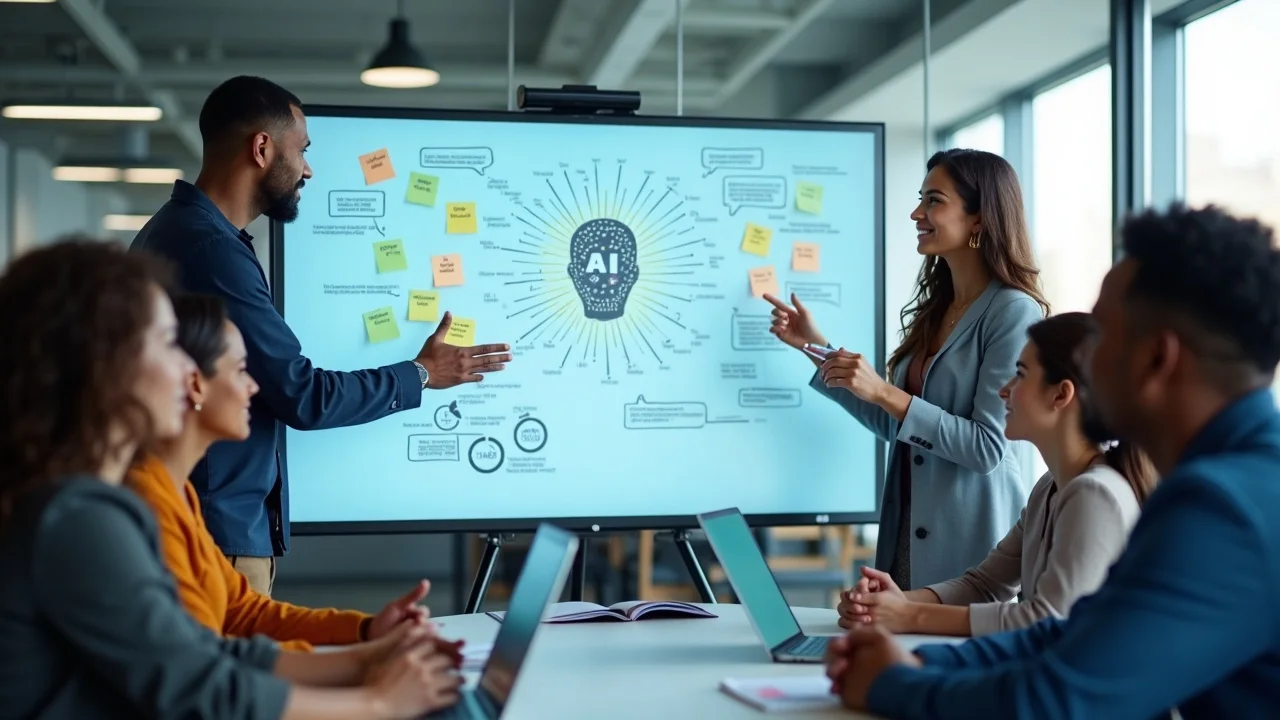
Imagine this: You’re in a brightly lit conference room—whiteboards glow with AI workflows, colleagues look at screens uncertainly, and the next steps seem both thrilling and overwhelming. No matter how many tools or promising pilots you try, it all feels stuck in “wait and see” mode. This is the crossroads where developing a healthy AI adoption mindset becomes not just helpful but critical to turning technology into transformation. In this article, I’ll synthesize patterns from organizational change, real-world AI initiatives, and leadership interviews to illuminate what a healthy, community-centered approach to AI adoption really looks like—and why it’s the anchor for lasting success.
A Scenario We All Recognize: Why Developing a Healthy AI Adoption Mindset Matters Now
For every organization and individual, the push to implement artificial intelligence is no longer hypothetical—it’s happening in meeting rooms, classrooms, nonprofits, and boardrooms around the world. Yet, despite the increasing accessibility of powerful AI solutions, many still find themselves grappling with doubt, resistance, and halted progress. Developing a healthy AI adoption mindset—one grounded in growth, responsibility, and curiosity—is the hinge on which successful AI transformation swings. It’s more than acquiring a new AI tool or rolling out another AI pilot; it’s a shift in culture, leadership, and vision.
We’ve all witnessed the energy drain in teams trying to keep pace with rapid AI innovation, only to have their efforts stall due to skepticism, fear of failure, or misplaced certainty. The difference between organizations that thrive and those that falter often comes down to mindset. Leaders and community members who choose a mindset of learning, open dialogue, and responsible innovation not only navigate change more effectively but also unlock AI’s full potential as a solution for real problems. That’s how AI adoption moves from yet another tech rollout to a catalyst for meaningful, sustained transformation.
What keeps organizations—and individuals—stuck?
Despite the promise of AI systems and tools, many organizations experience a stall in their transformation journey. The reasons are rarely technical; more often, resistance arises from ingrained habits, fixed assumptions, and a lack of clarity about how AI fits human goals. The allure of data sets and powerful language models can’t override everyday worries: Will I be replaced? Who decides what the AI output means? What if this model fails in a high-stakes moment? When teams equate AI adoption with a loss of agency, or a threat to established norms, progress falters.
At the individual level, fear of the unknown, pressure to deliver results with unproven AI tools, and past failures often breed skepticism. This isn’t a sign of weakness—it reflects genuine uncertainties about how much to trust a new AI system, or whether investment in upskilling is valued. Left unaddressed, these mindsets lead not only to stalled AI initiatives but also to declining morale, as excitement turns into fatigue. Tackling these barriers means getting curious about what truly drives resistance—and building solutions from that insight.
As you consider the importance of mindset in AI adoption, it's also valuable to explore how amplifying your unique voice and perspective can drive engagement and trust within your organization. For practical strategies on elevating your influence and fostering authentic communication, take a look at these insights on amplifying your voice in leadership and change.
Observing early patterns in AI adoption and resistance
Early adopters of AI innovation often share a few key behaviors: sustained curiosity, willingness to experiment, and the courage to acknowledge what isn’t working. In contrast, stories of resistance tend to surface where AI implementation has been framed as top-down or “one-size-fits-all,” or where the narrative assumes expertise is only the province of technical teams.
As a journalist who listens across communities, I see patterns repeat. Successful AI adoption is never just about deploying the latest AI model. Instead, it’s fostered by organizations that invest in nurturing a growth mindset, prioritizing dialogue over directives, and recognizing that resistance can be reframed as feedback for better solutions. Often, the first step toward progress is simply naming—out loud—where people are stuck and inviting diverse voices to reimagine what AI integration could look like in everyday work and life.
What You'll Learn by Exploring Developing a Healthy AI Adoption Mindset
Core principles of the growth mindset for AI adoption
How the right AI mindset accelerates change management
Real-world examples of responsible AI transformation
The interplay between continuous learning and successful AI integration
Foundations: The Components of Developing a Healthy AI Adoption Mindset

Growth Mindset versus Fixed Mindset in AI Contexts
The conversation about growth mindset—first popularized in education—has powerful implications for AI adoption. In a growth mindset, people believe that abilities can be developed through dedication, feedback, and learning. This contrasts sharply with a fixed mindset, where outcomes are attributed to innate talent or immutable skills. When brought into the realm of artificial intelligence, these mindsets influence everything from who feels empowered to experiment with new AI tools, to whether an organization bounces back from early setbacks or gives up too soon.
Teams and leaders with a growth mindset see unsuccessful AI pilots not as failure but as feedback, using what they learn to iterate and improve future AI solutions. They expect to “debug” both human and machine expectations, leveraging every challenge as a springboard for stronger collaboration. Conversely, a fixed mindset can result in dismissing AI system hiccups as evidence the technology “doesn’t fit here,” shutting down innovation prematurely and missing opportunities for true transformation. Successful AI implementation demands the courage to learn out loud, critique responsibly, and champion curiosity over certainty.
AI Mindset: What Does It REALLY Mean?
Developing a healthy AI adoption mindset means adopting a posture that’s flexible, inquisitive, and grounded in purpose. It’s not about idolizing technology or dismissing skepticism. Rather, it’s about treating AI as a dynamic partner in problem-solving, one that requires us to ask better questions, integrate diverse perspectives, and maintain awareness of our own assumptions.
The healthiest organizations view their AI mindset as a living asset: shaped by every new tool, model, and feedback loop. This mindset refuses to see AI as a threat or savior, but as a process that unfolds through continuous learning and shared dialogue. Here, leaders model transparency, encourage critical thinking, and create environments where it’s safe to ask, “What are we missing?” Above all, a healthy AI mindset understands that the most successful AI solutions emerge not from perfect code, but from teams willing to learn and adapt together.
“AI is not just a tool to be added; it’s an invitation to rethink the way we problem-solve, collaborate, and learn anew.” — Expert Spotlight
Responsible AI: Ethics and Purpose at the Core
No conversation about developing a healthy AI adoption mindset is complete without reckoning with Responsible AI. As AI systems increasingly shape outcomes across industries, grounding adoption in ethics and transparent intentions becomes essential. Responsible AI insists that we consider not just what a system can do, but what it should do, and how those decisions impact real people.
This means integrating fairness, accountability, and purpose directly into AI development—from curating input data sets to affirming clear use cases for every AI tool introduced. By putting ethics front and center, teams foster trust, reduce the risk of unintended bias, and help communities feel invested rather than sidelined. Practicing responsible AI reminds us: Adoption isn’t successful if it leaves stakeholders behind.

AI Adoption in Action: Stories and Successes from the Field
AI Integration: Case Studies from Community Innovators
In community after community, successful AI adoption looks less like a dramatic overnight change and more like a mosaic of small, sustained shifts. Consider a community health initiative using AI models to better allocate resources to at-risk populations—not as a replacement for local knowledge, but as an amplifier of it. Or, a public library leveraging generative AI tools to personalize digital literacy programs, guided by community feedback every step of the way. These stories reinforce a simple truth: effective AI integration thrives on partnership between technology and local insight.
Organizations that celebrate learning—rather than only polished outcomes—tend to foster deeper buy-in. Community innovators who share setbacks as openly as wins not only strengthen their AI solutions but also model resilience and adaptability for others. These cases highlight why a healthy AI mindset isn’t just “nice to have”; it’s the foundation on which real, sustainable change is built.
“Success with AI starts with curiosity, not certainty.” — Community Leader
AI Implementation: Building and Sustaining Change
The implementation of AI tools within organizations introduces both technical and cultural challenges. Achieving successful AI integration requires robust change management—ensuring everything from clear communication to continuous skill development. A healthy AI adoption mindset makes this process smoother by transforming uncertainty into opportunities for discussion and shared growth.
Adaptive teams anchor AI implementation efforts in dialogue, transparency, and incremental goal-setting. By expecting setbacks and designing for feedback, they create a culture where learning is viewed as ongoing, not a one-off effort. This turns AI adoption from a periodic disruption into a pathway for continuous improvement, where every challenge sharpens collective capabilities and strengthens resilience for future waves of technology.
AI Transformation and the Role of Change Management
True AI transformation doesn’t stop at deploying a new system; it transforms how people work, relate, and solve problems together. That shift is powered by thoughtful change management strategies—where leaders anticipate resistance, invite open-ended questions, and guide teams through both wins and discomforts. A growth-minded, community-first approach to change management helps organizations weather the turbulence of transition, supporting both high-performing teams and those still finding their footing.
The strongest AI transformations rest on clarity of values, regular communication about what’s changing (and why), and a commitment to upgrading skills across all levels. When everyone feels part of the journey—not just a passive recipient of new tech—the odds of successful AI adoption and business transformation soar.
Key Elements for Successful AI Adoption
Continuous Learning: Developing Skills, Habits, and Curiosity

Continuous learning is the heartbeat of developing a healthy AI adoption mindset. As AI solutions and models evolve, so must the skills, habits, and perspectives of the people using them. This means promoting a culture where experimentation, curiosity, and skill-building are recognized and rewarded—regardless of one’s initial AI expertise.
Successful organizations embed learning opportunities into daily routines, from peer-led workshops on new AI tools to regular reflection on what’s working (and what isn’t). Importantly, continuous learning helps communities embrace uncertainty as a space for growth—making it easier to navigate the complex shift from “knowing all the answers” to “asking better questions. ” Whether it’s upskilling for advanced AI model deployment or simply experimenting with a new generative AI tool, the healthiest environments see learning as a lifelong, collective pursuit.
Encouraging Community Buy-In for AI Solutions
Genuine AI adoption requires trust—across teams, departments, and entire communities. Fostering buy-in isn’t about top-down edicts or flashy launches; it’s about listening to people’s real questions, involving them in the process, and demonstrating how AI solutions can serve shared goals.
This might look like holding feedback sessions after each AI pilot, spotlighting local champions who’ve integrated new systems successfully, or amplifying the stories of everyday users whose lives have been improved by thoughtful AI development. By making everyone feel heard and valued, organizations create fertile ground for sustained, responsible AI adoption and stronger, more resilient business transformation.
Contrasting Growth Mindset and Fixed Mindset Approaches to AI Adoption |
|
Growth Mindset Approach |
Fixed Mindset Approach |
|---|---|
Encourages experimentation with AI tools and learning from setbacks. Welcomes feedback to improve future AI solutions and promotes sharing discoveries and questions openly with the community. |
Avoids risk, focuses on avoiding mistakes, and treats AI system setbacks as proof the technology “won’t work here.” Shuts down learning and feedback loops, perpetuating fear and resistance. |
Integrates ethics and responsibility into decision-making about AI innovation. Fosters continuous learning through upskilling, open discussion, and collective improvement. |
Ignores ethics or technical implications, prioritizing short-term results and focusing solely on expertise in technical teams. Rarely adjusts strategy in response to change or new insights. |
Digging Deeper: Four Mindsets That Shape AI Adoption

1. The Technologist’s Mindset
The technologist’s mindset centers on the capabilities and limitations of AI tools themselves—seeing AI development as an engineering challenge. While this lens is critical for building robust and effective AI models, it can sometimes downplay the social and human dimensions of AI adoption. Successful implementation requires blending this mindset with broader perspectives that account for the everyday contexts in which AI systems operate.
Technologists excel at rapid prototyping and technical innovation, but may need support in translating technical breakthroughs into solutions that resonate with non-expert users. By collaborating with stakeholders beyond the technical team and inviting feedback from diverse backgrounds, the technologist’s mindset becomes a powerful engine for impactful AI transformation.
2. The Human-Centered Mindset
A human-centered mindset puts people—their needs, values, and lived experiences—at the core of the AI adoption process. This approach emphasizes empathy, continuous learning, and real-world relevance. Rather than deploying technology for its own sake, the human-centered leader asks, “Who benefits, who is left out, and what would make this truly useful?”
Organizations that prioritize a human-centered approach often see higher community engagement, stronger trust between teams, and more adaptive solutions. They recognize that successful AI is not defined by technical prowess alone but by how well systems integrate with and uplift human work and culture.
3. The Systemic Mindset
The systemic mindset views AI adoption as part of a much larger network—connecting technology, people, processes, and organizational culture. Leaders with a systemic view recognize that introducing AI models or tools will have ripple effects, influencing everything from workflow design to data policy and even broader social dynamics.
A systemic mindset encourages organizations to anticipate challenges, measure impact holistically, and break down silos. It supports responsible AI deployment by integrating voices across departments, ensuring alignment with both organizational goals and evolving community needs. This is especially important for managing change at scale and achieving sustainable business transformation.
4. The Ethical Mindset
The ethical mindset focuses on embedding responsibility, transparency, and social impact into every phase of AI development and adoption. Leaders operating from this perspective champion fairness, question unintended consequences, and prioritize stakeholder trust above convenience or speed.
Fostering an ethical AI mindset means addressing bias in data sets, clarifying accountability for AI output, and engaging regularly with those affected by new AI systems. By making ethics a foundational element of AI innovation, organizations build more trustworthy, inclusive, and sustainable solutions.
How each mindset impacts AI solutions and outcomes
Ways to foster a balanced approach to adopting AI
Lists: Practical Habits for Developing a Healthy AI Adoption Mindset
Ask open-ended questions about AI’s role and potential
Listen to broad voices, not just internal experts
Invite healthy skepticism alongside curiosity
Invest in ongoing, context-specific education
Celebrate learning wins, not just finished projects

Expert Voices: How Leaders Foster a Healthy AI Mindset
“Trust builds when people see how AI helps their day-to-day work, not just the company’s bottom line.”
From community innovators to business leaders, one theme recurs: sustainable AI adoption depends on a trust-first posture. Leaders who model transparency, affirm the value of experimentation, and uplift diverse voices cultivate cultures where continuous learning and responsible innovation become the norm.
Many executives share that their own change management journeys began not with a new AI tool, but with a willingness to ask questions, admit what they didn’t know, and learn in public. By elevating these voices, organizations remind everyone that developing a healthy AI adoption mindset is a collective, ongoing effort.
Dynamic conversations with AI-savvy leaders captured in modern office settings. Watch as they share how curiosity, openness, and celebrating mistakes fuel their teams’ AI transformation and sustains momentum for continuous innovation. (Video description: Executives explain how growth mindset undergirds real-world AI adoption, with cutaways to team collaboration and captivating AI-themed animations. )
See how community members put healthy AI adoption mindsets into action — from local nonprofits piloting responsible AI to educators using generative AI for creative learning. Real voices, real questions, real results. (Video highlights include collaborative workshops, animated storytelling, and community feedback sessions. )
Troubleshooting Common Barriers to AI Integration
Recognizing resistance rooted in fear vs. logic
Aligning responsible AI values with practical outcomes
Navigating the tension between innovation and tradition
Addressing gaps in digital literacy

People Also Ask: How to Improve AI Adoption?
How to improve AI adoption?
Answer:
Improving AI adoption starts with fostering a growth mindset at every level of the organization. This means encouraging openness to experimentation, providing education tailored to varying levels of digital literacy, and inviting a diversity of perspectives—especially from those most impacted by new AI systems. Clear communication, proactive change management, and regular feedback loops help overcome resistance and ensure that the implementation process remains flexible and responsive. Above all, successful AI adoption is built on trust: teams must see not just the utility of the AI tool, but how it aligns with shared values and real-world needs.
What are the four AI mindsets?
Answer:
The four mindsets that most shape AI adoption are: the technologist’s mindset (focusing on technical innovation and system capabilities), the human-centered mindset (prioritizing user needs and real-world usefulness), the systemic mindset (considering ripple effects across teams, processes, and culture), and the ethical mindset (grounding decisions in fairness, transparency, and responsibility). Developing a healthy AI adoption mindset means weaving together these perspectives, inviting ongoing conversation about how to balance innovation, impact, and ethics.
What are the three qualities you need for successful AI adoption?
Answer:
Three essential qualities for successful AI adoption are: curiosity (a readiness to explore, question, and learn), adaptability (the willingness to iterate and adjust in response to feedback), and responsibility (a commitment to ethical considerations and community impact). These qualities anchor a strong culture of continuous improvement and elevate both technical outcomes and team wellbeing.
How to adopt a healthy mindset?
Answer:
Adopting a healthy mindset—whether in AI or other areas—means approaching challenges with openness and curiosity. It involves valuing growth over perfection, welcoming feedback, and seeking out diverse viewpoints. Practically, this looks like celebrating learning milestones, being transparent about uncertainties, and making space for asking questions without fear of judgment. Applying these habits to AI adoption leads to more resilient, engaged, and innovative teams.
FAQs on Developing a Healthy AI Adoption Mindset
Why is mindset more important than the AI tool itself?
Because even the best AI system can underperform if adopted by teams stuck in skepticism, fear, or rigid thinking.How can non-technical staff participate in AI transformation?
By providing feedback on system usability, sharing local expertise, and participating in collaborative learning about AI’s impacts.Can a mindset shift really change a stalled AI initiative?
Yes—many successful AI solutions began with a conscious effort to invite new ideas, adjust training approaches, and celebrate progress.What are signs that your organization needs a healthier AI mindset?
Signs include low engagement, avoidance of new tools, or viewing AI implementation as a threat rather than an opportunity.
Key Takeaways: Transforming Success through a Healthy AI Adoption Mindset

A growth mindset unlocks AI’s true potential.
Community and continuous learning drive meaningful AI adoption.
Responsible AI is everyone’s responsibility.
Mindset shifts lead to lasting transformation, not just tech upgrades.
Let’s Build Forward Together
If you’re ready to cultivate a growth mindset for AI adoption or want to bring your community into the future of responsible AI, schedule a 15 minute let me know further virtual meeting at https://askchrisdaley.com
Developing a healthy AI adoption mindset is just the beginning of your transformation journey. If you’re eager to deepen your impact and discover advanced strategies for amplifying your leadership presence in the age of AI, consider exploring how to amplify your voice and influence within your organization. By embracing both mindset and communication mastery, you’ll be better equipped to inspire trust, drive meaningful change, and lead your team confidently into the future of responsible AI. Take the next step to unlock your full leadership potential and shape a culture where innovation and community thrive together.
Sources
https://www.oreilly.com/radar/adopting-ai-mindset/ – O’Reilly Media
https://futureoflife.org/background/responsible-ai/ – Future of Life Institute
To deepen your understanding of cultivating a healthy AI adoption mindset, consider exploring the following resources:
“Embracing the AI Transition Mindset for Successful Adoption” (cgi.com)
This article discusses the importance of adopting an AI transition mindset that combines governance, ethical leadership, and proactive change management to harness AI’s full potential.
“Developing an AI First Mindset: Putting People at the Center of Business Transformation” (aileaderscouncil.org)
This piece emphasizes the significance of fostering an AI-first mindset that prioritizes curiosity, learning, and experimentation, placing people at the core of business transformation.
By engaging with these resources, you’ll gain valuable insights into the strategies and mindsets essential for successful AI integration within organizations.




Write A Comment